Archive for the 'Spanish Language' Category

Spanish Spelling Bee May Reflect a Rising Acceptance of the Language in the U.S.

The National Spelling Bee is a competition that is believed to have originated in the early 20th century in the United States, wherein a number of young contestants are required to a orally spell various words of increasing difficulty.  The first official Bee was held in 1925, and the first champion was eleven years old.  The tradition has since spread to many other nations.

For 85 years, the Bee was an English-only competition—a reflection of the country’s massive language majority.  Recently, however, a variant was introduced that caters to the largest (and ever-rising) minority language—Spanish.  The first annual Santillana National Spanish Spelling Bee was held in July 2011 in Albuquerque, New Mexico.  The winning word was Bizantinismo, spelled by 13-year-old Evelyn Juarez.

There are approximately 67 million native Spanish speakers in the U.S., and many more who speak it as a non-native language.  Although English is the de facto national language (and required for U.S. naturalization), it is not officially recognized/enforced on the federal level—perhaps a reflection of the nation’s rich history of immigration.

But although Spanish’s presence and influence is massive in the U.S., there are still many who resist its expansion, whether viciously, through xenophobic or anti-immigration policy and rhetoric, or less so, by promoting monolingualism as a necessary or preferred national linguistic policy.  The Spanish spelling bee, although still a very new tradition in the U.S., suggests a possibility for a rising adoption of the language, which already has very deep roots in the region.

The Second Annual Santillana National Spanish Spelling Bee was declared a tie, after two students surpassed 53 rounds of words—all that the competition had planned for—without making a single error.

The Third Annual Spanish Spelling Bee will be held this July, again in Albuquerque.

Some of the words included in the 2013 Spanish Spelling Bee
achicharrar
alcornoque
istmo
órdago
panadería
paspartú
rinoplastia
tortícolis

Monolingual vs. bilingual education: its implementation and effects

In Spain, a debate has been raging that extends beyond the subject to the language/s being used to propel it.   The subject is the language/s of education in Catalonia, the autonomous region of Spain whose official languages include both Catalan and Spanish.

Flags from  Spain and Catalonia

The factions are not as distinct as the languages, and the genesis of the debate is lengthy.  Although it has undoubtedly intensified in recent years, its roots go back to the late 70s, when Catalan was first introduced in the elementary and high schools in non-intensive/-exclusive way.  Since then, Catalan’s influence in education continued to grow, culminating in its 1992 ratification as the official language of instruction in all non-university schools and institutes in Catalonia.  The standard was reinforced by the Linguistic Policy Law of 1998 and again in 2006.  Soon after, a small group of Catalonians began to criticize the lack of Spanish in education, catalyzing several efforts (of varying degrees of success) to further include the language.

Although Spaniards are divided on the issue, with monolingual education—whether in Catalan or Spanish—being supported by some, and bilingual education by others, there does seem to be an aspect on which the factions almost unanimously agree: that the issue has become (or perhaps always was) excessively political, and that those who actually implement the policies, who educate, have had little say in the formation of such policies.

The voices of these individuals are beginning to emerge in various forums, but the debate continues still, a polemic most affecting those who have even smaller say than educators—the students themselves.

Particularities aside, the situation is representative of an important problem that all education systems, regardless of the region, state, or nation they correspond to, must face: that is, determining the best methodology with respect to language education (i.e. its policies and goals), and who should be made responsible for implementing it.

Private education might be considered a preemptory avoidance of the problem, although with its high cost and selectivity it may also be said to simply rearrange the imposition of specific, exclusive standards.  The fact that it is optional seems to be its only irrefutable point of exoneration.

However, that is assuming the students and others generally not involved in the formation of political and educational policy best know how to shape the educational system and, by extent, the future linguistic makeup of a place.  Most would grant that the majority of educators and politicians wielding power and influence likely wield knowledge and experience as well.

So, what’s the best way to handle the issue—in Catalonia, specifically, or more generally?  In another way: whose influence is best, most valid, true, etc., and how should it be promoted above the others?

The meaning of ‘junar’

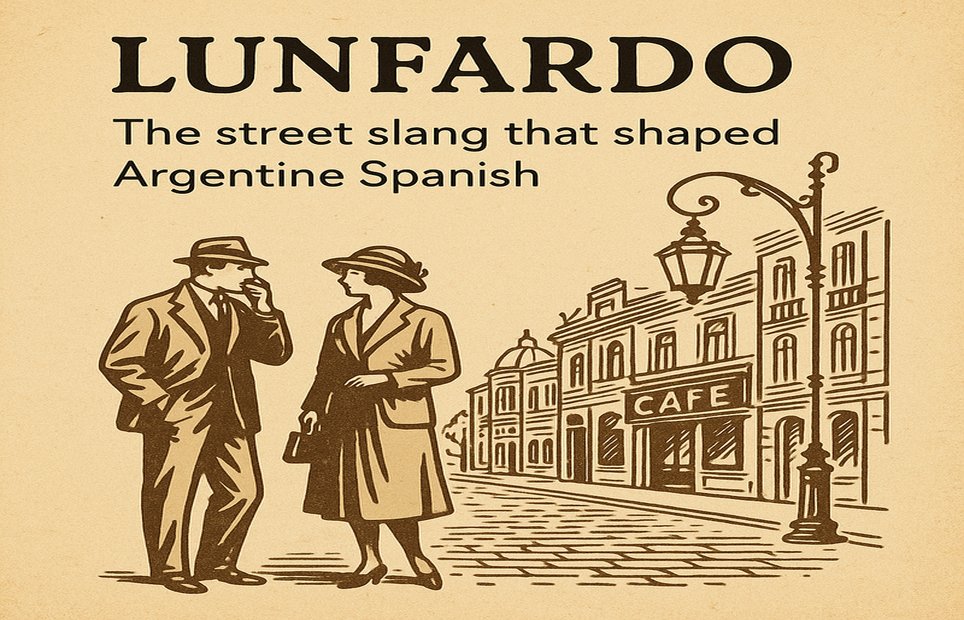
Argentine Spanish is strewn with words and colorful phrases from Lunfardo, a rich vocabulary born on the streets of Buenos Aires in the second half of the 19th century. Now considered a fixture of the Spanish language in Argentina (especially in and around Buenos Aires) and Uruguay, linguists cite the use of Lunfardo as a defining characteristic of the Rioplatense dialect. Add a dash of Argentine flavor to your Spanish vocabulary with the Transpanish blog’s ongoing feature highlighting some of the most frequently used terms in Lunfardo.

A popular lunfardo term is junar, a verb that is believed to have derived from the Romani language Caló of Spain and Portugal.   In this language, which has inspired many other lunfardo terms, junar means “to listen”. In modern use, though, the meaning has changed.

The first meaning may be described as “to watch” or “look”, although it is more specific than mirar or ver.  That is, junar is to look at someone in a roguish or even leering way.  Oftentimes, it can be used to describe a person’s excessively obvious/aggressive “romantic” gaze, e.g. Él te está junando “He is leering at you”.  Although it refers to a manner of looking in a specific time and space, it can also occasionally have implications beyond the particular instance.

The second meaning is basically synonymous with conocer, which also has a dual meaning—“to meet” or “to know”—though junar more closely compares to the later.  It can translate very directly to conocer in an example such as ¿Junás a María?
“Do you know María?” or less so in another, ¿Quién la juna a María?, which is a rather pejorative way to say that nobody knows María, or that she’s not worth knowing.

The third meaning may be considered a sort of extension of the first and second meanings.  That is, junar can be used both positivity and negatively with reference to a more essential characteristic or intention of a person—a characteristic beyond what is immediately, physically perceivable (e.g. a person’s manner of looking at).   A close common Spanish equivalent here might be a combination of conocer and entender.  Although it has a wider range of use than the first meaning, it commonly relates to romantic situations, e.g. La juna por la infidelidad “He/she knows she is unfaithful”.

It’s interesting to consider, first, how junar of lunfardo changed from the original form of “to listen” from Caló, and second, how the contemporary lunfardo meaning severed.  At what point did the division between listening and seeing begin to blur, or, was the change less organic, i.e. did the initial rioplantense user of it simply decide to do so in this new manner? Finally, the dual lunfardo meaning raises the question: at what point does a physical characteristic, such as a manner of looking at someone, become more than physical—that is, essential of a person?

The word junar turns up in the lyrics of the tango “Atenti Pebeta” by Ciciarco Ortiz and Celedonio Flores.

Cuando estés en la vereda y te fiche un bacanazo,
vos hacete la chitrula y no te le deschavés;
que no manye que estás lista al primer tiro de lazo
y que por un par de leones bien planchados te perdés.

Cuando vengas para el centro, caminá junando el suelo,
arrastrando los fanguyos y arrimada a la pared,
como si ya no tuvieras ilusiones ni consuelo,
pues, si no, dicen los giles que te han echao a perder.

Si ves unos guantes patito, ¡rajales!;
a un par de polainas, ¡rajales también!
A esos sobretodos con catorce ojales
no les des bolilla, porque 1e perdés;
a esos bigotitos de catorce líneas
que en vez de bigote son un espinel…
¡atenti, pebeta!, seguí mi consejo:
yo soy zorro viejo y te quiero bien.

Abajate la pollera por donde nace el tobillo,dejate crecer el pelo y un buen rodete lucí,
comprate un corsé de fierro con remaches y tornillos
y dale el olivo al polvo, a la crema y al carmín.Tomá leche con vainillas o chocolate con churros,
aunque estés en el momento propiamente del vermut.
Después comprate un bufoso y, cachando al primer turro,
por amores contrariados le hacés perder la salud.

The Language of the future: Chinese, English or Spanish?

Free image courtesy of FreeDigitalPhotos.net

For most former, current or potential foreign language learners, one of the most important motivations for doing so involves the language’s future relevance—both as the language is being learned and afterward; in other words, the question of What will learning this language do for me?.  Of course, this varies from person to person—as do the more general, unintended circumstances of learning—, but some of the most common motivations include business competitiveness, immigration, travel, and personal study/improvement, among others.

Recent language growth trends shed some light on these motivations, i.e. who they propel to learn foreign languages—or, more importantly, which languages appeal most inclusively to the myriad relevancies and learning circumstances. Currently, the three most widely spoken languages are Chinese, Spanish and English, at 1.2 billion, 329 million and 328 million speakers, respectively.  Trends of the Internet, perhaps the most inclusive global communication device, are most useful to contextualizing the figures.  In 2000, there were roughly 34, 187 and 20 million online users of Chinese, English and Spanish, whereas in 2011 these numbers had risen to 509, 565 and 164 million.

Given its monumental rise in popularity, it seems that Chinese will likely be one language of the future—perhaps the language, i.e. that which comes to dwarf all others.  This is, of course, assuming that the Internet’s influence will continue to rise—to blur geographic boundaries—; for as it stands, Chinese’s geographic reach is far smaller than that of English and Spanish.

Related to this is the fact that traditional methods of language spread have been basically unaffected by the Internet—chief among them, immigration.  The United States is a prominent example: each year, 700 thousand to one million people legally migrate to the country, and over half of these come from Spanish-speaking countries.  Of the estimated 300 thousand undocumented immigrants that arrive each year, the percentage is even higher.  Whether intentional or not, this results in a massive rise of both English and Spanish in the U.S., a process not matched by Chinese beyond its originating region.  Besides, the process inevitably transfers and acquires more than just language: there is the speakers’ community and culture too, which further motivates and gives relevance to the learners’ efforts.

Because of nations such as the U.S., with their large populations of native Spanish speakers, native English speakers, and bilingual speakers living closely together, some believe that one language of the future might be more fully developed variant of Spanglish.  Considering this alongside the Internet’s seemingly indefinite growth, it’s not difficult to imagine a sort of mutant world language combining not only English and Spanish, but also Chinese, among others.

What do you think? Will the Internet, immigration, and other forces ultimately homogenize languages, or will the majority of popular languages maintain their numbers and continue to thrive independently?

Difficulties of ‘sounding right’ when learning English or Spanish as a second language

When learners of any non-native language reach a level of intermediate-to-advanced comprehension, new preoccupations emerge.  In English, we might describe one of these as “speaking so it sounds right”, but of course the crux of this—“sounds”—is not so simple as the statement suggests.

languages sounds

Free image courtesy of FreeDigitalPhotos.net

One obvious sort of “sound” is pronunciation, the predictable ways of saying vowels and consonants.  For native English speakers learning Spanish, this is above all an effort of repetition, as the pronunciation of all vowels and (most) consonants is fixed.  Once you learn the patterns, you’ve just got to practice.  There are several variations, though; for example, the pronunciation of ll and y.

For native Spanish speakers learning English, however, the process is not so simple.  Although Spanish, like English, varies from region to region, these varieties are, once learned, predictable.  Pronunciation variance only truly exists for Spanish speakers who are exposed to multiple Spanish-speaking regions.  This is not the case for English, whose pronunciation system is fundamentally varied.  An easy example is the pronunciation of the a in cat versus that in cape.  The “rules” are complex and imperfect and, to an extent, mastering pronunciation is a process of trial-and-error.

Another sort of “sound” is the rhythm or isochrony of a language, and with this both English and Spanish learners struggle.  For native English speakers learning Spanish, the language can seem faster than their mother tongue, whereas for native Spanish speakers learning English, the latter can seem slower or unpredictable.  Again, a fundamental difference emerges here: Spanish is “syllable-timed”, and English is “stress-timed”.

Basically, in Spanish, all of the syllables should take the same amount of time to say.   Because the frequency varies from speaker to speaker (and from time period to time period), it is not accurate to generalize Spanish as a “faster” language.  In English, syllables last different amounts of time, but without any sort of diacritical indicators.  This is an understandably complicated system for many native Spanish speakers.   Ostensibly, one could perfectly understand written English without having the slightest idea of how to correctly read it aloud.

However, it’s also worth noting that these categorizations are imperfect—most notably with respect to the syllable breakdown in Spanish.  In poetry especially, but in everyday speech as well, Spanish often exhibits elision, or the limiting or even complete omission of syllables.  This most commonly occurs in the present perfect form; for example, when saying he elegido (I have chosen), likely the first two syllables would be nearly synthesized to one.  This is understandably difficult for non-native Spanish speakers to recognize in speech, let alone authentically reproduce.

Keeping these aspects of sound in mind, both English and Spanish learners will be able to not only speak more correctly, but improve their listening comprehension skills.  Furthermore, reading in the second language will achieve new texture, for the voices—be they of particular characters or the narrator—will begin to resonate on more than a visual level.

When learners of any non-native language reach a level of intermediate-to-advanced comprehension, new preoccupations emerge.  In English, we might describe one of these as “speaking so it sounds right”, but of course the crux of this—“sounds”—is not so simple as the statement suggests.

One obvious sort of “sound” is pronunciation, the predictable ways of saying vowels and consonants.  For native English speakers learning Spanish, this is above all an effort of repetition, as the pronunciation of all vowels and (most) consonants is fixed.  Once you learn the patterns, you’ve just got to practice.  There are several variations, though; for example, the pronunciation of ll and y. 

For native Spanish speakers learning English, however, the process is not so simple.  Although Spanish, like English, varies from region to region, these varieties are, once learned, predictable.  Pronunciation variance only truly exists for Spanish speakers who are exposed to multiple Spanish-speaking regions.  This is not the case for English, whose pronunciation system is fundamentally varied.  An easy example is the pronunciation of the a in cat versus that in cape.  The “rules” are complex and imperfect and, to an extent, mastering pronunciation is a process of trial-and-error. 

Another sort of “sound” is the rhythm or isochrony of a language, and with this both English and Spanish learners struggle.  For native English speakers learning Spanish, the language can seem faster than their mother tongue, whereas for native Spanish speakers learning English, the latter can seem slower or unpredictable.  Again, a fundamental difference emerges here: Spanish is “syllable-timed”, and English is “stress-timed”. 

Basically, in Spanish, all of the syllables should take the same amount of time to say.   Because the frequency varies from speaker to speaker (and from time period to time period), it is not accurate to generalize Spanish as a “faster” language.  In English, syllables last different amounts of time, but without any sort of diacritical indicators (i.e. link to http://en.wikipedia.org/wiki/Diacritic).  This is an understandably complicated system for many native Spanish speakers.   Ostensibly, one could perfectly understand written English without having the slightest idea of how to correctly read it aloud. 

However, it’s also worth noting that these categorizations are imperfect—most notably with respect to the syllable breakdown in Spanish.  In poetry especially, but in everyday speech as well, Spanish often exhibits elision, or the limiting or even complete omission of syllables.  This most commonly occurs in the present perfect form; for example, when saying he elegido (I have chosen), likely the first two syllables would be nearly synthesized to one.  This is understandably difficult for non-native Spanish speakers to recognize in speech, let alone authentically reproduce. 

Keeping these aspects of sound in mind, both English and Spanish learners will be able to not only speak more correctly, but improve their listening comprehension skills.  Furthermore, reading in the second language will achieve new texture, for the voices—be they of particular characters or the narrator—will begin to resonate on more than a visual level. 

History of the letter eñe

Most people associate the letter eñe with the Spanish language. Yet it is actually present in no less than nine different alphabets spanning the globe, including the modern Latin alphabet, Galician alphabet, Asturian alphabet, Filipino alphabet and Guarani alphabet, among others. Additionally, it is currently used to represent the [ŋ] in the Tartar and Crimean languages, along with the Chamorro, Mandinka, Mapudungun and Tocharian languages. Considering the usage of eñe, it quickly becomes clear that the letter is present in a variety of geographical locations, and is used in languages stemming from different language families.

The tilde that sits atop the n to form what is now a separate letter in its own right, originally began as shorthand. It represented a double letter, in this case nn, which was used more frequently in Old Spanish. The word año, for example, was formerly anno and derived from the Latin word annvs. While this usage spread to many languages at the time, most of them eventually dropped the tilde. Meanwhile, Spanish retained its usage as shorthand for a double letter.

As far back as Medieval Latin usage, that tilde came to represent a nasal sound following a vowel (then also used on the letter m). The presence of eñe in Spanish has since expanded to all instances in which the palatal nasal sound is present, even when it does not represent a former double letter, such as with señor.

More recently, there has been cross-linguistic usage in native languages located in or near predominantly Spanish-speaking areas. These languages include Aymara, Quechua, Basque, Leonese, Yavapai, and Tetum. The orthographies of these native languages and others with cross-linguistic usage of eñe all have some basis in Spanish. It is also present in English words borrowed from Spanish, such as jalapeño, piñata, and piña colada.


Spanish Keyboard Layout – Latin America. The letter eñe is on the right of the L.

Tip!
Alt key code for the letter eñe: ALT + 0241.

Suscribe to our blog!

Enter your email address:

Delivered by FeedBurner