
Spanish Is the Second Most Widely Spoken Language in the World
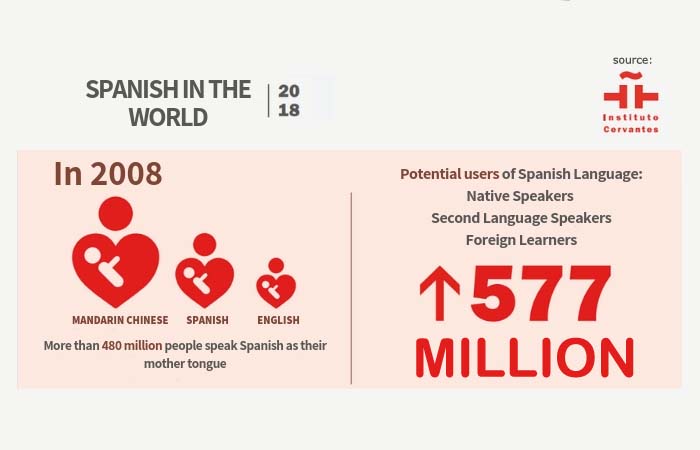
According to the latest annual report from the Spanish language institute, the Instituto Cervantes, more than 577 million people around the world speak Spanish, some 7.6% of the global population. By 2050, the Spanish speaking population is expected to increase to 756 million, an increase of 0.1%. This makes it the second most widely spoken […]
The Differences between Castilian Spanish and Latin American Spanish
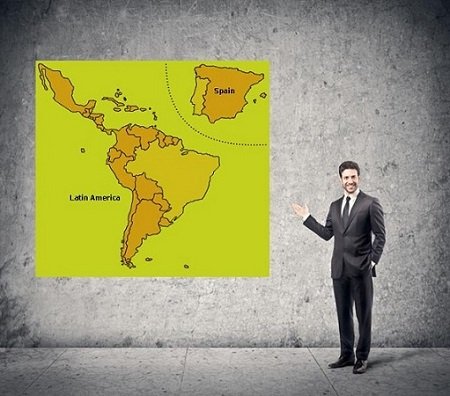
Castilian Spanish – so named for its roots in the region of Castile – emerged from Spain’s many regional languages and dialects to become the primary language of the nation. Castilian Spanish was later brought to the New World through the colonization efforts of the Spanish, where the language enjoyed widespread adoption throughout the Americas. […]
Spanish Language Characteristics. Spanish in the World.

Spanish is the most widely spoken of the Romance languages, both in terms of number of speakers and the number of countries in which it is the dominant language. Besides being spoken in Spain, it is the official language of all the South American countries except Brazil and Guyana, of the six republics of Central […]
Facts about the rapid growth of the Spanish language
Soraya Sáenz de Santamaría, Vice President of Spain, recently recalled the roots and history of the Spanish language. She noted the landmarks and influencers of the language that helped to grow Spanish around the world. Such ventures include the expeditions of Christopher Columbus and the philosophy of writers like Mario Vargas Llosa and Gabriel García […]
Lunfardo: what do “garpar” and “garpe” mean?
One of the most interesting features of Lunfardo – an Argentine dialect of Spanish that arose in the late 19th century among petty criminals living with immigrants and native Argentines in the sheet metal tenements of lower-class Buenos Aires neighborhoods – is its great capacity for metathesis, the re-arrangement of sounds or syllables in a […]
New Spanish Certification Test Created
Students of most major foreign languages can demonstrate their skill level via a variety of internationally-recognized tests, including the TOEFL and IELTS for English, the DALF for French and the Goethe-Zertifikat for German. Until just a couple of months ago, however, Spanish had no international exam for certifying proficiency. This unfortunate situation has […]
The U.S. – Number One in Spanish Speakers by 2050
Today, more than 548 million people – or 6.7% of the world’s population – speak Spanish, and for 470 million of these, Spanish is their native or dominant language, according to the “El Español: Una Lengua Viva” report issued by Instituto Cervantes. Mexico tops the list with almost 121 million Spanish speakers, followed by Colombia […]
Italianisms in Lunfardo – Part II
Continuing on with our last article, on Italianisms in the Lunfardo dialect, which originated in working class districts in Buenos Aires in the late 19th century, below are several more interesting Lunfardo words. Mistongo (from mishio, an Italianism derived from the Genovese miscio) -The original Genovese word meant “without money” and has generalized to include […]
Italianisms in Lunfardo – Part I
The Lunfardo dialect of Spanish arose in the last quarter of the 19th century among petty criminals living with immigrants and native Argentines in the conventillos – sheet metal tenements – of lower-class neighborhoods in Buenos Aires. Because so many of these immigrants (some ten million between 1821 and 1932) were poorly educated or illiterate […]
Croqueta, azotea and coco: Some lunfardo words for head
Lunfardo is a rich and often slyly humorous dialect, and nowhere is its imaginative use of language more evident than with the plethora of words it has for “head” (cabeza in standard Spanish). As can be expected, many of these terms are related to its shape: coco – coconut mate – the hollowed-out gourd used […]