Archive for the 'Latinos' Category

Castilian Spanish Versus Latin American Spanish

Castilian Spanish – so named for its roots in the region of Castile – emerged from Spain’s many regional languages and dialects to become the primary language of the nation. Castilian Spanish was later brought to the New World through the colonization efforts of the Spanish, where the language enjoyed widespread adoption throughout the Americas. Over time, Latin American Spanish has evolved in its own right to contain various features that distinguish it from European Spanish.

The use of the term “castellano” as opposed to “español” when referring to the Spanish language may be interpreted in a number of ways. Since there are several official languages in Spain including Catalan, Basque, and Galician, the word “castellano” is often used to differentiate the Spanish language from these regional languages. Castellano may also be used to refer to regional dialects of the Spanish language spoken in Castile, for example, Andalusian. Many times – particularly outside of Spain – castellano and español are utilized interchangeably and simply refer to the Spanish language as a whole.

The terms Castilian Spanish or castellano are often used to draw a distinction between the Spanish spoken in Spain (Peninsular Spanish) and Latin American Spanish; however, this usage is somewhat misleading since Spanish speakers in Latin America also speak what are essentially dialects of Castilian Spanish as opposed to a distinct language, as is often implied.

Many Spanish speakers in Latin America customarily refer to their language as castellano as opposed to español. For example, Southern Cone countries such as Argentina and Uruguay have a tendency to refer to Spanish as castellano, while other parts of South America alternate between the use of the terms español and castellano. In the U.S., Mexico, Central America and the Caribbean, Spanish is almost exclusively referred to as español.

While there is no generic form of Latin American Spanish, many countries share several features of pronunciation, vocabulary and grammar that set apart Latin American Spanish from Castilian Spanish.

Read more about Latin American Spanish and Castilian Spanish

Spanish Speakers in U.S. Exposed to Dangerous Pharmacy Errors

Apparently, speaking Spanish in the United States can be hazardous to one’s health. According to a recent study to be published in the journal Pediatrics, Spanish speakers are exposed to an unacceptable number of grave translation errors in the instructions provided with prescription medications. Pharmacists’ computers frequently deliver “Spanglish” translations, which ultimately pose a threat to patients’ health, as they are open to misinterpretation and therefore possible overdose. Overloaded pharmacists who are lacking Spanish-language skills simply do not have the time or ability to review the prescription labels for errors.

The best way that non-English speaking patients can protect themselves from misunderstandings when dealing with medical professionals is to request an interpreter or translator with expertise in the medical field in order to receive instructions and other vital information in their native tongue. In addition, the pharmaceutical industry should push for the hiring of more bilingual pharmacists and the development of more advanced pharmacy prescription software that produces clearer translations when the use of automatic translation is unavoidable.

Click here for more information on this story from HealthDay.com.

Visit our Pharmaceutical Glossary for English and Spanish terms and our Pharmaceutical Abbreviations section for English and Spanish Meaning of Latin Abbreviations in the Pharmacy Industry.

Studies Reveal Inadequacies in Marketing to the Latino Demographic

Although the Latino market in the United States continues to grow exponentially, many marketers have yet to effectively learn how to tap into this key demographic. With Hispanic spending power approaching the $1 trillion mark, it’s hard to believe that retailers aren’t working more aggressively to capture the attention of this influential segment; however, the truth is that many businesses have yet to wake up to the importance of marketing to the Latino community.

A recent survey of marketers conducted by Orcí – a leading Hispanic advertising and marketing firm – revealed that only 50% of marketers direct their advertising specifically at the Latino segment. While “the majority of respondents believe Hispanics will have a significant impact on a variety of aspects of American culture” [1] including food, fashion and beauty, and technology, the vast majority of marketers don’t plan to specifically target the Latino demographic in the upcoming year.

According to the Orcí survey, nearly 40% of marketers question the return on investment that a Latino marketing campaign would bring, while approximately 30% feel that their company’s current marketing strategy is effective for the Latino segment.

In addition to the lack of attention paid to Hispanics in the traditional realms of advertising such as TV, radio and print, marketers have also neglected to reach out to this segment through trends such as social media (e.g. Twitter, Facebook, and MySpace).

In a separate study conducted by AOL, findings revealed that most companies that have attempted to reach out to their Hispanic customers online are going about it in the wrong way. Spanish sites are often poorly translated, resulting in a mere shadow of the English version of the company’s online presence. Even when retailers do get it right and hire a translator to create a top-notch, professional translation, the message frequently fails to connect with readers because it hasn’t been specifically tailored to Hispanics.

“Hispanics are tech savvy, young trend setters with incredible spending power,” Orcí said. “Companies that recognize the potential of the market by effectively engaging them will see a return on their investment.” [2]

[1] Orcí 2010 Hispanic Marketing Trends Survey
[2] BizReport, Hispanic-specific marketing found lacking

Latinos and the 2010 U.S. Census

With the 2010 U.S. Census set to begin in March, members of the Latino community are at odds over their participation in the decennial survey. Some fear that the census data collected by the government could provide an inaccurate tally of the population. “Concerns about an accurate count of the Latino community partly stem from the outcome of the 2000 census, when the Census Bureau estimated that it over-counted the total population by 1.3 million people while under-counting Hispanics by 250,000.” [1]

Accurate census data that reflects the true makeup of the population is of great importance; decisions regarding the distribution of federal funding for community projects and political representation rely heavily upon information culled from the census. An inaccurate representation of the population could lead to the loss of federal dollars for services that would benefit the Latino community.

The language barrier is one of the principal threats to the accuracy of the Latino count. Advocates are hopeful that the government will hire additional Spanish-speaking census workers to conduct field interviews and outreach with Latinos who may be wary of completing census forms. The Census Bureau announced that 13 million bilingual census forms would be printed to promote increased participation in the government headcount.

Undocumented immigrants within the Hispanic community are far less likely to complete census forms out of fear of an investigation or raid by Immigration and Customs Enforcement (ICE), though the Census Bureau asserts that the information collected is not shared with other government agencies and is kept confidential for a period of 72 years. [2]

Hispanic advocacy groups have been running informational campaigns to educate Hispanics about the census and to encourage participation. The Latino interest group known as the National Association of Latino Elected Officials (NALEO) even went so far as to create Christmas-themed census posters “showing Mary and Joseph heading to Bethlehem for a census and the birth of Jesus,” a move that stirred up controversy among religious conservatives and the broader Latino community. [3]

Unfortunately, the poster controversy served to widen the rift between Latinos who are promoting participation in the census and those who are urging a boycott to protest the crackdown by federal authorities on illegal immigration, as well as the lack of movement on immigration reform.

More information on the Hispanic Community in U.S

[1] ABC News, High-Stakes Census for Latinos Complicated by Fears
[2] Census.gov, 2010 Census Constituent FAQs
[3] The Washington Post, Hispanic leaders disagree over Christmas-themed census poster

How Hispanic Immigrants and Their Families Fare in the U.S.

The impact of immigration on the U.S. over the years in undeniable, but what sort of influence is the U.S. having on recent Latino immigrants and successive generations of “native Latinos” born on American soil?

A study undertaken by the Pew Hispanic Center shows that U.S.-born Latinos expressed optimism regarding their economic futures, and they expect to improve upon the previous generation’s financial status. The study also revealed some troubling statistics concerning the Latino population, including higher-than-average dropout and teen pregnancy rates for newly-arrived immigrants, as well as a propensity for gang involvement and violence among native Latinos.

Analysts predict that within 15 years, 25% of college-aged students will be Latino. As such, advocacy groups are encouraging politicians to look beyond Hispanic stereotypes and to work toward creating transitional programs to assist Latino students with the demands of higher education in order to ensure their success.

Read more about the study and its findings here.

Latinos and the Nonprofit Sector

With the Hispanic segment of the U.S. population growing rapidly, it’s no wonder that retailers have begun to sit up and take notice of this group’s influence; however, it’s undeniable that the non-profit sector needs to engage Latinos as well in order to advance their agendas.  Hispanics have a great deal to offer nonprofit organizations in the way of volunteerism and monetary contributions, but just as corporate outfits must modify their advertising approach for the Hispanic market, non-profit organizations must also find new approaches to actively engage Latinos.  “A launch into the Hispanic market is essential to any organization’s survival…but it’s not something that can happen without proper planning and thought.” [1]

One of the key means of reaching out to Spanish-speaking donors or potential volunteers is by securing a professional translation of all copy such as brochures, press releases, and fundraising letters.  While many Latino communities in the U.S. prefer information in English, be sure to provide literature that shows sensitivity to the traditions, norms, and other cultural subtleties that are unique to your prospective donors or volunteers.  Avoid using the same English-language materials that were developed for your non-Latino audience.

While traditional written materials are a mainstay of any fundraising or volunteer campaign, the power of the Internet and social media should not be overlooked.  According to Vanguard Communications, a public relations and social marketing firm based in Washington, D.C., “The number of Latinos using social media is growing exponentially, but the number of organizations tweeting in both English and Spanish is still fairly small.  A Facebook fan page or Twitter account dedicated to your issue is a popular mechanism for providing Spanish-language updates and action steps and promoting the offerings through your other outreach efforts.” [2]

A nonprofit organization looking to establish loyalty toward its cause must focus on getting to know its audience, encouraging involvement and demonstrating a commitment to the Latino community.  “The U.S. census identifies Latinos as a young population, indicating the majority has not reached their primary giving years,” thus the development of a thoughtful strategy for capturing Hispanic donors and volunteers has the potential to reap great rewards in the future. [3]  Latinos who perceive themselves as valued, respected and an integral part of an organization’s agenda will prove to be an invaluable resource to nonprofits as they look to advance their worthwhile causes and efforts.

[1] Fundraising Success, Conference Roundup: Reaching the Hispanic Population
[2] Vanguard Communications, Understanding Trends in Hispanic Outreach
[3] Association of Fundraising Professionals, Diversity Essay: Latino philanthropy in the U.S.

The Use of Neutral Spanish for the U.S. Hispanic Market

There is little doubt about the growing influence of the Hispanic demographic in the United States.  According to the latest data from the U.S. Census Bureau, Latinos comprise 14.8% of the population for a total of 44.3 million people.  What’s more, Hispanics are projected to account for almost 25% of the total U.S. population by the year 2050.[1]  The incredible cultural and linguistic diversity of the U.S. Hispanic population presents a challenge for retailers and other businesses who want to reach out to the Latino segment and harness the economic potential within that group.  So, how does one effectively communicate with and market to an audience consisting of cultures from across the Spanish-speaking world?  The answer lies in the use of neutral Spanish.

When creating advertising campaigns, website content, or other materials geared toward the U.S. Hispanic audience, companies are wise to consider the use of neutral Spanish, which avoids regionalisms, colloquial language, and certain verb tenses and conjugations that hint at a particular dialect.  Translators and writers employing neutral Spanish seek to produce a text that is universally understood by Spanish speakers.  Given the dynamic nature of the Latino community, a translator should have contact with the Hispanic market in the U.S. in order to make the best decisions regarding word choice.

The use of neutral Spanish for Latino audiences is gaining traction in television and radio as well.  The rise in popularity of neutral Spanish on the airwaves signals a real change in how U.S. Hispanics view themselves as a unique community apart from their respective countries of origin.  Ilan Stavans, Professor of Latin American and Latino culture at Amherst College in Massachusetts, notes, “It is a widespread trend that is quite significant because it says much about how Latinos in the U.S. are consolidating their own identity.” [2]

Though neutral Spanish lacks an equivalent in the real world (think Received Pronunciation in the U.K. or Standard American English in the U.S.), erasing traces of a telltale accent from spoken Spanish or country-specific slang from the written word serves to avoid confusing or even offending the audience and goes a long way in appealing to the broad Hispanic demographic in the United States.

References:
[1] Hispanic Population of the United States, U.S. Census Bureau
[2] American Spanish?  Telemundo coaches “neutral” accents, Hispanic American Center for Economic Research (HACER)

Lunfardo: The Slang of Buenos Aires
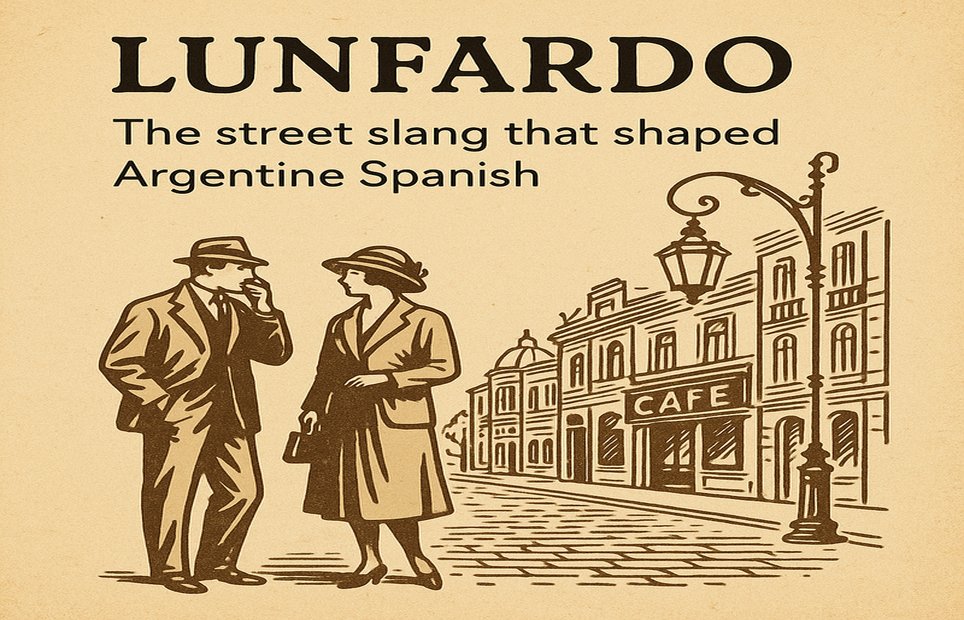
Argentine Spanish is peppered with words and phrases from Lunfardo, a vast slang vocabulary developed on the streets of Buenos Aires around the turn of the 20th century.  Criminals and other shady characters looking to keep their activities under wraps developed Lunfardo by borrowing and twisting words from the melting pot of languages that surrounded them, allowing them to communicate with each other even in the presence of the police or prison guards.  While initially used by the more unsavory element of Argentine society, Lunfardo was later popularized through the tango, literary art forms, and upwardly mobile immigrants and has become a part of everyday, informal speech regardless of social class.  Today, the use of Lunfardo is most prevalent in Argentina (particularly in and around Buenos Aires) and Uruguay, though some elements have been adopted by neighboring countries such as Chile and Paraguay.

Lunfardo was largely a product of the great wave of European immigration to Argentina that took place from the late 1800s through the mid-1900s.  The huge influx of immigrants hailing from Spain, Italy and France, many of whom spoke non-standard regional dialects or languages, greatly influenced the development of Lunfardo.  Certain words also arrived via the gauchos from Argentina’s interior as well as from native groups like the Guaraní, Quechua and Mapuche.

One of the features of Lunfardo is the use of vesre, a form of wordplay that involves reversing the order of syllables in a word.  The term “vesre” is derived from the Spanish word “revés” (in reverse/backwards).  Examples of vesre include café → feca (coffee), pantalones → lompa (a truncated form of the word for pants) and hotel → telo (a pay-by-the-hour love motel).

In addition to vesre, Lunfardo also employs words based on metaphors such as tumbero, a slang term for “convict” that originates from the Spanish word “tumba” meaning grave.  Another example is the word “campana” (Spanish for “bell”), which describes the lookout man ready to sound the alarm should the police suddenly arrive on the scene.

For those of you looking to add a splash of color to your Spanish, the following websites have compiled an extensive list of Lunfardo words and phrases: Argentine Spanish Slang Dictionary, Wally’s Dictionary of Argentine Colloquialism and Culture and Diccionario de Lunfardo.

Notable Hispanic and Latino Americans – Part II

Part II of our list of some notable Hispanic and Latino Americans, citizens or residents of the United States with ancestry or origins in Hispanic America.

Education

Richard A. Tapia selected for the National Science Board (governing board for the National Science Foundation) by President Bill Clinton.

Richard A. Tapia (born March 25, 1939) is a renowned American mathematician and champion of under-represented minorities in the sciences. In recognition of his broad contributions, in 2005, Tapia was named “University Professor” at Rice University in Houston, Texas, the University’s highest academic title. The honor has been bestowed on only six professors in the Rice’s ninety-four year history. Tapia is currently the Maxfield and Oshman Professor of Engineering; Associate Director of Graduate Studies, Office of Research and Graduate Studies; and Director of the Center for Excellence and Equity in Education at Rice University.

Tapia’s mathematical research is focused on mathematical optimization and iterative methods for nonlinear problems. His current research is in the area of algorithms for constrained optimization and interior point methods for linear and nonlinear programming.

Music

Tito Puente (Puerto Rico)
Tito Puente, Sr., (April 20, 1923–May 31, 2000), born Ernesto Antonio Puente, Jr., was an Latin jazz and mambo musician. The son of native Puerto Ricans Ernest and Ercilia Puente, of Spanish Harlem in New York City, Puente is often credited as “El Rey” (the King) of the timbales and “The King of Latin Music”. He is best known for dance-oriented mambo and Latin jazz compositions that helped keep his career going for 50 years. He and his music appear in many films such as The Mambo Kings and Fernando Trueba’s Calle 54. He guest starred on several television shows including The Cosby Show and The Simpsons.

Carlos Santana (Mexico)
Carlos Augusto Alves Santana (born July 20, 1947) is a Mexican-born American Grammy Award-winning rock musician and guitarist. Santana became famous in the late 1960s and early 1970s with his band, Santana, which pioneered a blend of rock, salsa and jazz fusion. The band’s sound featured his melodic, blues-based guitar lines set against Latin percussion such as timbales and congas. Santana continued to work in these forms over the following decades. He experienced a sudden resurgence of popularity and critical acclaim in the late 1990s. Rolling Stone also named Santana number 15 on their list of the 100 Greatest Guitarists of All Time in 2003

Visual arts

Franck de Las Mercedes, painter
Franck de Las Mercedes, (b. 1972 in Masaya, Nicaragua) is a Nicaraguan American artist, based in New York. He was raised in a family of Nicaraguan folklore dancers, musicians and teachers, and spent his childhood immersed in the performing arts. In the mid-eighties, the Sandinista/Contra war forced Franck’s family to immigrate to New York where Mercedes grew up and worked in music and theatre, studying under Gail Noppe-Brandon. In the late nineties he began working as an artist.

He has painted small empty boxes, a public art project called the Priority Boxes, labelled with the words “PAZ”, “JUSTICIA”, “TRANQUILIDAD”, and “AMOR”, which he sends around the world for free. This mail art project started in 2006. “The Priority Boxes” project is a public art series that seeks, to make people reconsider their ability to influence change, question the fragility and priority of entities like peace, and also to communicate, interact through art and make it accessible to people from all walks of life.

Soraida Martinez, Artist, Creator of Verdadism (Mexico)
Soraida Martinez is a contemporary abstract expressionist artist who creates hard-edge paintings. She was born in Harlem, New York City, USA on July 30, 1956.

Since 1992 Soraida Martinez has been known as the creator of Verdadism, a form of hard-edge abstraction where each painting is accompanied by a written social commentary. Martinez is the only artist to write a social statement for every painting that she creates. Viewers are drawn to both the artist’s abstract paintings and her bold commentaries on humanity and the universal human condition. According to Martinez’ artist’s statement, “My art reflects the essence of my true self and the truth within me…My struggle is for recognition, acceptance and inclusion; and, against racism, sexism and the dominant eurocentric male society, which never expected much from me but still did not allow my voice to be heard. My belief is that one must empower oneself with one’s own truth…”.

Sciences

Fernando Caldeiro, astronaut (Argentina)
Fernando “Frank” Caldeiro (b. June 12, 1958 in Buenos Aires, Argentina) is an American astronaut (Class XVI) with a degree in mechanical engineering from the University of Arizona and the University of Central Florida.

Caldeiro, whose ancestors are from Galicia, is currently assigned to high altitude research flights in the NASA WB-57 aircraft.

In 2002, he was appointed to the President’s Advisory Commission on Educational Excellence for Hispanic Americans.

Mario Molina, Nobel Prize-winning chemist (Mexico)
José Mario Molina-Pasquel Henríquez (born March 19, 1943 in Mexico City) is a Mexican-born American chemist and one of the most prominent precursors to the discovering of the Antarctic ozone hole. He was a co-recipient (along Paul J. Crutzen and F. Sherwood Rowland) of the 1995 Nobel Prize in Chemistry for his role in elucidating the threat to the Earth’s ozone layer of chlorofluorocarbon gases (or CFCs), becoming the first Mexican-born citizen to ever receive a Nobel Prize in Chemistry.

Basketball

Manu Ginóbili, NBA player (Argentina)
Emanuel David “Manu” Ginóbili (born 28 July 1977 in Bahía Blanca, Argentina) is an Argentine professional basketball player. Coming from a family of professional basketball players, he is a member of the Argentine men’s national basketball team and the San Antonio Spurs in the National Basketball Association (NBA).

Ginóbili spent the early part of his basketball career in Argentina and Italy, where he won several individual and team honors. His stint with Italian side Kinder Bologna was particularly productive, earning two Lega A Most Valuable Player awards, the Euroleague Final Four MVP and the 2001 Euroleague and Triple Crown championships. The shooting guard was selected as the 57th overall pick in the 1999 NBA Draft and is considered one of the biggest draft steals of all time. Ginóbili returned to Italy and only joined the Spurs in 2002. He did not take long to establish himself as a key player for the Spurs, and has since won three NBA championships as well as being named an All-Star in 2005. In the 2007–08 season, he was named the NBA Sixth Man of the Year.

Francisco García, NBA player (Dominican Republic)
Francisco García (born December 31, 1981, in Santo Domingo, Dominican Republic) is a Dominican professional basketball player who currently plays for the Sacramento Kings of the NBA. A 6’7″, 195-pound guard–forward from the University of Louisville, García was selected by the Kings in the first round (23rd overall) of the 2005 NBA Draft. He now plays a variety of positions for the Kings, and on September 25, 2008, signed a five-year extension with the Kings. It was worth $23 million.

As a college basketball player at Louisville under coach Rick Pitino he enjoyed great success along with future NBA player Reece Gaines. He averaged 15.7 points per game as a junior and, along with teammate and best friend Taquan Dean, led his 4th-seeded team to the 2005 Final Four in Saint Louis, Missouri. Forgoing his senior season, García decided to go professional and enter the ranks of the NBA. In his rookie season for the Kings, García appeared in 67 games (11 starts) and averaged 5.6 points per game.

Source: Wikipedia

Notable Hispanic and Latino Americans

List of some notable Hispanic and Latino Americans, citizens or residents of the United States with ancestry or origins in Hispanic America

Architecture

Eduardo Catalano, architect (Argentina)
Eduardo Fernando Catalano (born 1917) was born in Buenos Aires, Argentina and came to the United States on a scholarship to the Universities of Pennsylvania and Harvard. In 1945, after earning his second Master’s Degree in architecture, Catalano taught at the Architectural Association in London until 1951, when he came back to the U.S. as a Professor of Architecture at the School of Design in Raleigh, North Carolina State University. In 1956 he began teaching in the graduate program for MIT, until 1977, when he moved on “to discover and participate in other endeavors as rewarding as teaching”
Catalano had an “understanding of the indivisible relationship between space and structure”, which earned him praise from Frank Lloyd Wright, who wrote to House and Home magazine when he saw the publishing of the “Raleigh House” AKA the Catalano House to say “It is refreshing to see that the shelter, which is the most important element in domestic architecture, has been so imaginatively and skillfully treated as in the house by Eduardo Catalano” Catalano sold the house when he moved to Cambridge, Massachusetts to teach at MIT. Years of neglect at the end of the 20th century culminated in the house’s demolition in 2001.

Other buildings designed by Catalano include the US embassies in Buenos Aires, Argentina and in Pretoria, South Africa, the Juilliard School of Music at New York City’s Lincoln Center, Guilford County Courthouse in Greensboro, North Carolina, and the Stratton Student Center at MIT in Cambridge, Massachusetts.

Rafael Moneo, architect (Spain)
José Rafael Moneo Vallés (born May 9, 1937) is a Spanish architect. He was born in Tudela, Spain, and won the Pritzker Prize for architecture in 1996. He studied at the ETSAM, Technical University of Madrid (UPM) from which he received his architectural degree in 1961. From 1958 to 1961 he worked in the office in Madrid of the architect Francisco Javier Sáenz de Oíza. He has taught architecture at various locations around the world and from 1985 to 1990 was the chairman of Harvard Graduate School of Design, where he is the first Josep Lluís Sert Professor of Architecture. In 1997, he became Academic Numerary in the Royal Academy of Fine Arts of San Fernando in Madrid in May 1997.

Spanish constructions of his design include the renovation of the Villahermosa Palace (Thyssen-Bornemisza Museum) in Madrid, the National Museum of Roman Art in Mérida, Spain, an expansion of the Atocha Railway Station (also in Madrid), the Diestre Factory in Zaragoza, Pilar and Joan Miró Foundation in Majorca the headquarters of the Bankinter (again, in Madrid), Town Hall in Logroño. He also designed the annex to the Murcia Town Hall, which was completed in 1998. His latest work is the enlargement of the Prado Museum, its greatest expansion in 200 years of history.

Some of Moneo’s prominent works in the US include the Cathedral of Our Lady of the Angels in Los Angeles, the Davis Art Museum at Wellesley College in Massachusetts and the Audrey Jones Beck Building (an expansion of the Museum of Fine Arts, Houston). Moneo also designed the Chace Center, a new building for the Rhode Island School of Design. He is currently working on an Interdepartmental Science Building at Columbia University in New York City.

Dance

José Limón, modern dancer and choreographer (Mexico)
José Arcadio Limón (January 12, 1908 – December 2, 1972) was a pioneering modern dancer and choreographer. He was born in Culiacán, Sinaloa, Mexico, the eldest of 12 children. He moved to New York City in 1928 where he studied under Doris Humphrey and Charles Weidman. In 1946, Limón founded the José Limón Dance Company. His most famous dance is The Moor’s Pavane (1949), based on Shakespeare’s Othello and set to music by Henry Purcell.

Danielle Polanco, dancer and choreographer (Puerto Rico)
Danielle Polanco (born October 26, 1985) is an elite dancer and choreographer. She is probably best known for being the leading lady in Omarion’s music video Touch and for playing in the 2008 movie Step Up 2 the Streets, in which she portrayed Missy Serrano. Polanco has an impressive resume; she has choreographed for Beyonce and Janet Jackson and has also appeared as a dancer in numerous music videos for top artists such as Beyonce, Amerie, Janet Jackson, and Usher. Danielle is a member of the House of Ninja. She is of Puerto Rican and Dominican descent. She’s from and still lives in the Bronx borough of New York City. Most recently, she can be seen in the Broadway revival of West Side story as one of the Shark girls. She is the dance captain for the show.

Fashion

Gisele Bündchen, model (Brazil)
Gisele Caroline Bündchen (born July 20th, 1980 in Horizontina, Rio Grande do Sul, Brazil) is a Brazilian model and occasional film actress. According to Forbes, she is the highest-paid model in the world and also the sixteenth richest woman in the entertainment world, with an estimated $150 million fortune.

Carolina Herrera, fashion designer (Venezuela)
Carolina Herrera (born María Carolina Josefina Pacanins y Niño on January 8, 1939), Marchioness of Torre Casa, is a venezuelan fashion designer and entrepreneur who founded her eponymous company in 1980.

Herrera was born in Caracas, Venezuela. Based in New York City since 1981, throughout the 1970s and 1980s she was named one of the best dressed women in the world. Her empire grew rapidly and steadily and she went on to dress Jacqueline Kennedy Onassis for the last 12 years of her life.

Herrera is married to Reinaldo Herrera Guevara, Marqués de Torre Casa, an editor at Vanity Fair magazine, with whom she had two daughters. She was previously married to Guillermo Behrens Tello, with whom she had two daughters as well.

Carolina Herrera is a Goodwill Ambassador and Facilitator for the Intergovernmental Institution for the use of Micro-algae Spirulina Against Malnutrition, IIMSAM, and its affirmative action programme, The Right to Food Campaign Initiative Against Malnutrition and Fashion United Against Malnutrition. IIMSAM works to promote the use of micro-algae Spirulina (Spirulina Platensis) to counter malnutrition and its severe negative impacts especially in the Developing and Least Developed Countries (LDC). Carolina states: “If my work at the IIMSAM were to save the life of even one child from the forty thousand children that die of malnutrition and related diseases each day, I would consider it the greatest work of my life.”

Ms. Herrera is a recipient of The International Center in New York’s Award of Excellence.

Film and TV

Jessica Alba, actress (Mexico)
Jessica Marie Alba (born April 28, 1981) is an American television and film actress. She began her television and movie appearances at age 13 in Camp Nowhere and The Secret World of Alex Mack (1994). Alba rose to prominence as the lead actress in the television series Dark Angel (2000–2002). Alba later appeared in various films including Honey (2003), Sin City (2005), Fantastic Four (2005), Into the Blue (2005), Fantastic Four: Rise of the Silver Surfer and Good Luck Chuck both in 2007.

Alba is considered a sex symbol and often generates media attention for her looks. She appears frequently on the “Hot 100″ section of Maxim and was voted number one on AskMen.com’s list of “99 Most Desirable Women” in 2006, as well as “Sexiest Woman in the World” by FHM in 2007. The use of her image on the cover of the March 2006 Playboy sparked a lawsuit by her, which was later dropped. She has also won various awards for her acting, including the Choice Actress Teen Choice Award and Saturn Award for Best Actress (TV), and a Golden Globe nomination for her lead role in the television series Dark Angel. Her acting has also been criticized, as she has been nominated for numerous Razzie Awards throughout her career. Alba’s offscreen, personal life has been a frequent subject of media, celebrity

Benicio del Toro, actor (Puerto Rico)
Benicio Monserrate Rafael del Toro Sánchez (born February 19, 1967), better known as Benicio del Toro, is a Puerto Rican actor and film producer. His awards include the Academy Award, Golden Globe, Screen Actors Guild (SAG) Award and British Academy of Film and Television Arts (BAFTA) Award. He is known for his roles as Fred Fenster in The Usual Suspects, Javier Rodríguez Rodríguez in Traffic, Jack ‘Jackie Boy’ Rafferty in Sin City, Dr. Gonzo in Fear and Loathing in Las Vegas, Franky Four Fingers in Snatch and most recently Che Guevara in Che. He is the third Puerto Rican to win an Academy Award.

Literature

Isabel Allende, writer (Chile)
Isabel Allende Llona, (born in Lima, Peru; 2 August 1942), is a Chilean-American writer. Allende, whose works sometimes contain aspects of the “magic realist” tradition, is one of the first successful women writers in Latin America. She is largely famous for her contributions to Latin-American literature, novels such as The House of the Spirits (La casa de los espíritus) (1982) and City of the Beasts (La ciudad de las bestias) (2002), which have been hugely successful. She has written novels based in part on her own experiences, often focusing on the experiences of women, weaving myth and realism together. She has lectured and done extensive book tours and has taught literature at ten American colleges. Having adopted American citizenship in 2003, she currently resides in California along with her husband. Her writings are comparable to those of Gail Anderson-Dargatz, Louise Erdrich and Laura Esquivel. Isabel Allende is of Basque, Spanish and Portuguese descent.

Gabriel García Márquez, author (Colombia)
Gabriel José de la Concordia García Márquez (born March 6, 1927) is a Colombian novelist, short-story writer, screenwriter and journalist. García Márquez, affectionately known as “Gabo” throughout Latin America, is considered one of the most significant authors of the 20th century. In 1982, he was awarded the Nobel Prize in Literature. He pursued a self-directed education that resulted in his leaving law school for a career in journalism. From early on, he showed no inhibitions in his criticism of Colombian and foreign politics. In 1958, he married Mercedes Barcha; they have two sons, Rodrigo and Gonzalo.

He started as a journalist, and has written many acclaimed non-fiction works and short stories, but is best-known for his novels, such as One Hundred Years of Solitude (1967) and Love in the Time of Cholera (1985). His works have achieved significant critical acclaim and widespread commercial success, most notably for popularizing a literary style labeled as magical realism, which uses magical elements and events in otherwise ordinary and realistic situations. Some of his works are set in a fictional village called Macondo, and most of them express the theme of solitude.

Source: Wikipedia