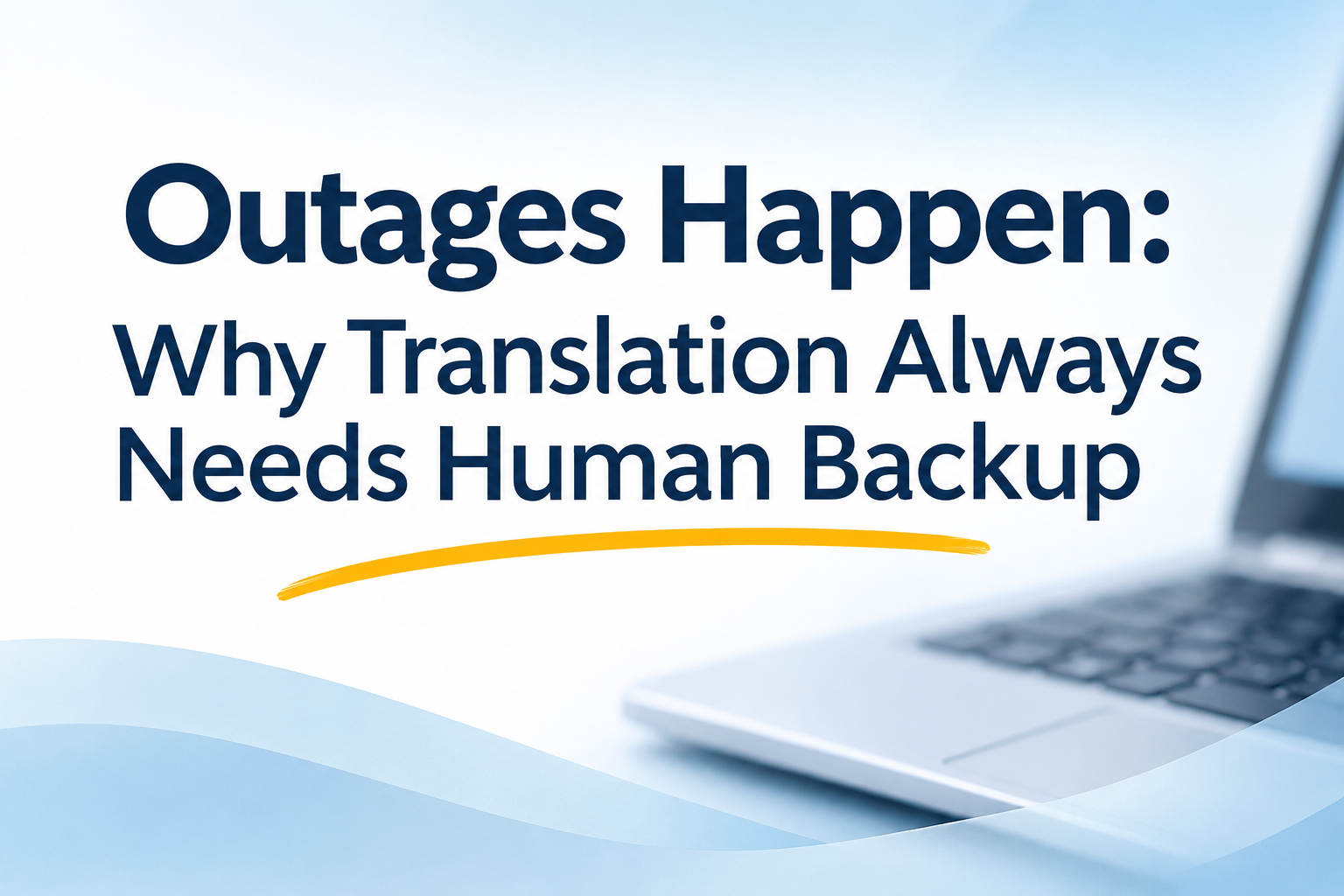
Recent outages affecting major digital platforms have brought this question into sharp focus. When essential services go down, businesses can lose hours—or even days—of productivity. Deadlines are missed, projects are delayed, and the financial consequences can quickly add up.
As companies increasingly rely on artificial intelligence and automated workflows, an important question emerges: Are we becoming so dependent on technology that we’re overlooking the human expertise needed when things go wrong?
The Hidden Cost of Technological Dependence
Cloud-based platforms, AI-powered tools, and automated systems have transformed how businesses operate. They offer remarkable advantages in speed, efficiency, and scalability.
The translation industry is no exception.
Machine translation and AI-assisted workflows have made it possible to process large volumes of multilingual content faster than ever before. For many organizations, these technologies have become an essential part of daily operations.
But efficiency comes with a potential vulnerability: the more dependent we become on a particular system, the greater the disruption when that system fails.
When critical systems become unavailable, the consequences can extend beyond lost productivity. Disrupted communications, missed business opportunities, and recovery efforts can all generate unexpected costs.
Technology can make businesses more efficient, but efficiency without a contingency plan can leave them exposed.
What Happens When AI-Powered Translation Tools Stop Working?
Imagine a company preparing to launch a multilingual marketing campaign. Its translation workflow relies almost entirely on an AI-powered platform.
The content is ready, the deadline is approaching, and the company expects the translations to be delivered within hours.
Then the platform becomes unavailable.
Without an alternative workflow, the project may come to a halt. The company might need to wait for the service to be restored, potentially delaying its campaign and affecting other teams involved in the launch.
Now consider a different scenario.
The company works with a professional language service provider that combines technology with experienced translators and editors. Essential files and terminology resources are accessible, and alternative workflows have been established.
Even if a particular platform becomes unavailable, qualified linguists can assess the situation, prioritize urgent content, and help keep the project moving.
Of course, human translators also depend on technology. Computers, internet connections, and translation software are integral to modern language services.
The advantage is not that humans can operate entirely without technology. It is that experienced professionals can adapt, make decisions, and find alternatives when automated processes are disrupted.
Human Expertise Is More Than a Backup Plan
The conversation about artificial intelligence often focuses on productivity, cost savings, and the possibility of replacing human tasks.
Yet something important can get lost in that discussion: the value of professional knowledge.
In translation, qualified linguists do much more than transfer words between languages.
They interpret meaning, understand cultural context, recognize terminology inconsistencies, and make decisions based on the intended audience and purpose of a text.
These skills are particularly valuable in specialized fields such as healthcare, legal services, education, and corporate communications, where linguistic errors can have serious consequences.
AI can be an extremely useful tool in these environments, but its output still requires an appropriate level of professional oversight.
And when automated systems fail, having access to experienced professionals becomes even more valuable.
Human expertise provides not only linguistic quality but also flexibility, judgment, and the ability to respond to unexpected circumstances.
Does Your Translation Strategy Include a Contingency Plan?
Most companies understand the importance of backing up their data. Many invest in cybersecurity, disaster recovery, and business continuity planning.
But how many have considered what happens when the AI tools and automated platforms supporting their everyday operations suddenly become unavailable?
In multilingual communications, a contingency plan might include:
- Maintaining relationships with qualified translators and language service providers.
- Keeping secure, accessible copies of essential documents, translation memories, and terminology databases.
- Avoiding complete dependence on a single technological platform.
- Establishing alternative workflows for urgent or business-critical content.
- Ensuring that experienced professionals remain involved in quality assurance and decision-making.
These measures are not about rejecting innovation. They are about making innovation more sustainable.
Having qualified human support already in place can make the difference between a manageable interruption and a costly operational setback.
The Future of Translation Is Not About Choosing Between AI and Humans
Artificial intelligence is here to stay, and its benefits for the language industry are undeniable.
At Transpanish, we recognize the value of technology in improving efficiency, supporting translation workflows, and helping businesses manage multilingual content.
But we also believe that technological progress should not come at the expense of human expertise.
The strongest translation strategies are not necessarily those that automate the greatest number of tasks. They are those that balance efficiency, quality, flexibility, and reliability.
This means knowing when automation is appropriate, when professional human intervention is essential, and how to maintain operations when the unexpected happens.
Recent technology outages offer a timely reminder that no digital system is infallible.
Businesses should embrace AI and automation, but they should also ask themselves whether they have the people, resources, and processes needed to keep working when those systems become unavailable.
Because the real question isn’t whether technology will fail at some point. It’s whether your business will be prepared when it does.
At Transpanish, we combine modern translation technology with the expertise of professional linguists to provide reliable English–Spanish and English–Portuguese language services. From human translation and professional editing to AI-assisted workflows and linguistic quality assurance, we help businesses communicate effectively without losing sight of the value of human expertise.