What is inclusive Spanish, and why does it go beyond just one letter?
Inclusive language has gained visibility in Spanish-speaking institutions, schools, and social spaces. Yet, in Spanish, the debate is often reduced to a single letter: the “e.” This way of speaking or writing, which seeks to avoid the exclusive use of the grammatical masculine, is neither a recent fad nor a passing whim. It’s part of a broader process of linguistic, social, and cultural transformation aimed at making historically excluded identities and realities visible. But inclusive Spanish is much more than swapping letters—it’s about rethinking how we communicate.
How did inclusive Spanish emerge?
A brief history and evolution of its forms
Challenges to the generic masculine in Spanish gained strength in the 1970s and 1980s. At first, strategies like word doubling (“todos y todas” / “all men and all women”) were promoted to explicitly highlight binary genders. Later came proposals such as the “@” symbol and the letter “x” to represent supposed gender neutrality, especially in written form. However, these options proved impractical for spoken Spanish, difficult to read, and problematic in terms of accessibility.
The “e” (as in todes instead of todos) arose as a response to those limitations: an alternative that can be read, pronounced, and understood easily, while also including non-binary people or identities not represented by the gender binary. This evolution reflects an ongoing search: how to build Spanish that represents without excluding, is useful without being unreadable, and is socially transformative without losing clarity.
Why do some people oppose inclusive Spanish?
Common criticisms and current tensions
Criticism of inclusive Spanish comes from many directions. Some argue it “breaks the rules” of grammar, makes reading harder, or isn’t necessary because “the masculine already includes everyone.” Others reject it for ideological or political reasons, framing it as a cultural imposition.
Interestingly, most critiques don’t address the purpose of inclusive Spanish, but rather its surface forms. The “e,” the “x,” or the “@” are attacked, while the deeper issue is ignored: that some people do not feel represented by the way Spanish has traditionally been used. Like all languages, Spanish evolves with society, and naturally sparks debate when it reflects deeper social tensions.
Why does inclusive Spanish matter?
It’s not just about words—it’s about representation
Language doesn’t just reflect reality: it shapes it. When we speak or write in Spanish, we don’t just describe the world—we help define it. That’s why using Spanish that represents more people isn’t simply about political correctness; it’s a concrete form of inclusion.
Inclusive Spanish has a performative effect. When we name someone, we make them visible. When we don’t, we erase them. That’s why adjusting how we speak and write in Spanish can have a real impact on how people feel when they hear or read our words. Inclusion begins with language.
Is inclusive Spanish only about gender?
Key insights for truly inclusive communication
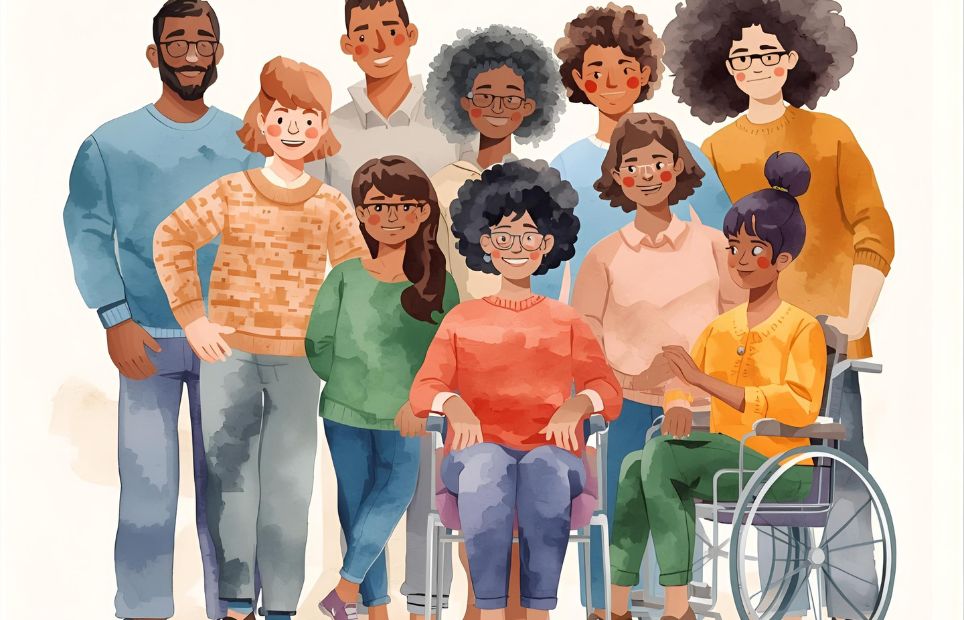
Inclusive Spanish goes far beyond avoiding the generic masculine. It also involves rethinking how we talk about people with disabilities, racialized communities, body diversity, migrants, older adults, and other groups.
For example:
- Say “persona con discapacidad” (person with a disability) instead of “discapacitado” (the disabled), prioritizing the person over the condition.
- Use “persona sin discapacidad” (non-disabled person) or “persona neurotípica” (neurotypical person) instead of “persona normal” (normal person).
- Avoid slurs like “¡qué mogólico!” or “es retrasado,” and choose respectful, precise terms.
Truly inclusive Spanish considers multiple dimensions of identity and avoids normalizing stereotypes or hierarchies.
When does inclusive Spanish stop being effective?
Common pitfalls and how to avoid them
The goal of inclusive Spanish is to promote understanding and representation, but its overuse or mechanical application can backfire. Texts overloaded with “e,” “x,” or “@” can become unreadable, feel forced, or even exclude people with visual or reading disabilities.
Awkward examples:
- “Les niñes fueron con sus amigues y les docentes.”
- “Lxs usuarixs deben completar el formularix.”
Better alternatives:
- “La infancia fue al parque con el equipo docente” (Children went to the park with their teachers).
- “Quienes usan el servicio deben completar el formulario” (Service users must complete the form).
The key is striking a balance between inclusion, clarity, and naturalness.
What does the Royal Spanish Academy (RAE) say about inclusive Spanish?
The official stance on social change
The RAE (Real Academia Española) has repeatedly rejected nonstandard inclusive forms. In 2020, it reaffirmed that the grammatical masculine is “generic” and supposedly includes all genders. It also dismissed expressions like todes, niñes, or chiques, arguing they don’t fit Spanish morphology.
However, language is not just about rules—it’s about use. While language academies like the RAE have influence, language practices are transformed through everyday use, especially in activism, education, social media, and media outlets. The acceptance of new forms depends not only on rules but also on their usefulness, social legitimacy, and adaptability.
How and when should inclusive Spanish be used in translation?
Best practices for adapting content sensitively
Applying inclusive Spanish in translation requires judgment, audience awareness, and cultural context. It’s not about automatically inserting the “e” into every noun. It’s about analyzing each text and adapting it with intelligence and sensitivity.
Some tips:
- Use collective forms when possible: el alumnado (students), el equipo (staff), las personas trabajadoras (employees).
- Choose impersonal structures: quienes participan (those who participate), se solicita completar… (please complete…).
- Evaluate the original tone to decide if inclusion should be visible or subtle.
Not all texts allow the same level of intervention. A youth campaign may welcome disruptive language, while a technical or legal report requires other strategies. And not all clients explicitly request inclusive language. Translators play a key role in listening, advising, and proposing. If appropriate, an inclusive approach can be recommended—but always respecting the client’s needs and goals. True inclusion in translation is contextual, not automatic.
Language is never neutral: it reflects and shapes our ideas about the world. Adopting inclusive practices in Spanish isn’t about imposing a new code—it’s about opening the language to more voices, more identities, and more ways of existing.
At Transpanish, we offer translations with an inclusive perspective, as well as adaptations of existing Spanish texts to achieve communication that is clear, respectful, and aligned with your organization’s values.
Want your Spanish message to be clear, respectful, and inclusive? Rely on Transpanish.