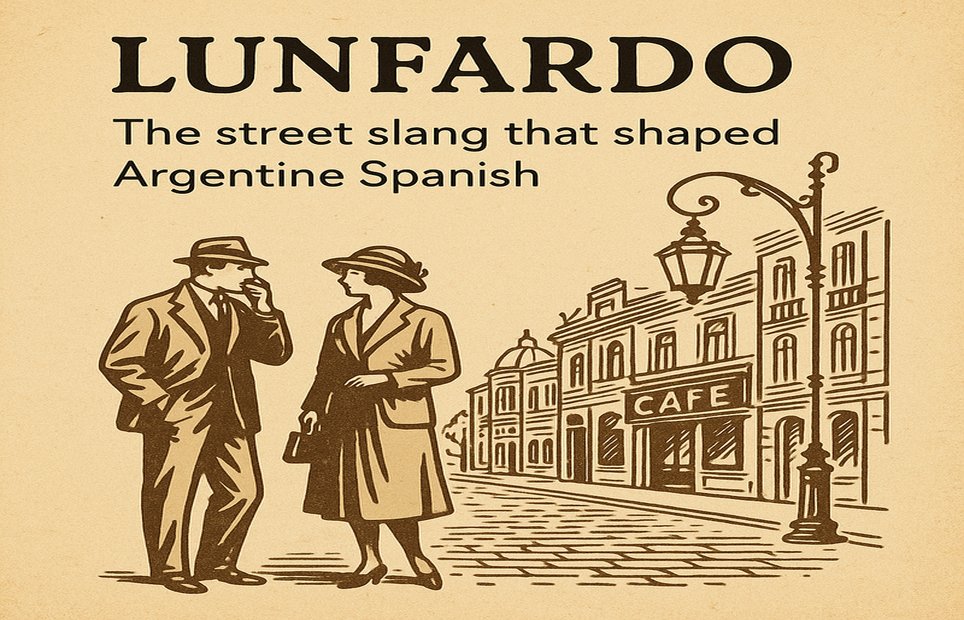
Argentine Spanish is peppered with words and phrases from Lunfardo, a colorful and ever-evolving slang born on the streets of Buenos Aires in the second half of the 19th century. What began as a secret code among criminals, gamblers, and other shady characters, has grown into one of the most distinctive linguistic hallmarks of Argentine identity.
From secret code to cultural icon
Originally, Lunfardo served as a kind of verbal disguise. People from the city’s underworld used it to conceal their conversations from the police, prison guards, and outsiders. They borrowed and twisted words from the melting pot of languages spoken by European immigrants—particularly Italian, Spanish, and French—as well as from indigenous languages and regional dialects. Over time, this hybrid tongue became so rich and expressive that it escaped its criminal origins and seeped into popular culture.
The rise of tango played a crucial role in the spread of Lunfardo. Tango lyrics, written in the cafés, brothels, and working-class neighborhoods of Buenos Aires, immortalized Lunfardo terms that spoke of love, betrayal, nostalgia, and the bittersweet life of the city’s poor and immigrant communities. Soon, poets, playwrights, and songwriters began to use Lunfardo as a way of capturing the authentic voice of Buenos Aires, transforming what was once street slang into a cultural symbol. By the mid-20th century, Lunfardo had become deeply ingrained in everyday, informal speech across all social classes.
A language born from immigration
Linguistically, Lunfardo is a fascinating mosaic. It absorbed countless words from the massive wave of immigration that reshaped Argentina between the late 1800s and mid-1900s. The majority of newcomers came from Italy—especially from regions like Genoa and Naples—and their dialects left an indelible mark on local Spanish. For instance, the Italian lavorare (to work) became laburar (to work), and femmina (woman) evolved into mina (girl). There were also contributions from French—like morfar (to eat) and atorrante (loafer or vagrant)—as well as from indigenous languages such as Guaraní, Quechua, and Mapuche. Some expressions even came from the countryside, brought by migrants familiar with the language of the gauchos, Argentina’s traditional horsemen. The exact origins of many Lunfardo words remain controversial, as they often reflect overlapping influences from several languages spoken in Buenos Aires at the time.
Wordplay and wit: the spirit of Lunfardo
One of the most playful aspects of Lunfardo is the use of vesre, a kind of linguistic mirror that flips syllables in reverse. The word “vesre” itself comes from revés (“backwards”). This clever manipulation gave birth to gems like feca (from café, coffee), lompa (from pantalones, pants), and telo (from hotel, now used for a pay-by-the-hour motel). Vesre still thrives in Buenos Aires today, especially in humor, song lyrics, and everyday banter.
But Lunfardo’s creativity doesn’t stop there. It also thrives on metaphor and imagery. For example, tumbero—slang for a convict—comes from tumba (grave), reflecting the idea of someone “buried” in prison. Another classic term is campana (literally “bell”), used for the lookout who keeps watch and warns accomplices of approaching police. Many Lunfardo words are rooted in wit, irony, and the city’s unique sense of humor, giving Argentine Spanish its unmistakable rhythm and personality.
More than slang: a living cultural heritage
Today, Lunfardo is most alive in Argentina (especially Buenos Aires) and Uruguay, where it forms an essential part of the porteño identity. Some expressions have even crossed borders into Chile, Paraguay, and other neighboring countries. Linguists continue to document and study it, noting how new words—often influenced by youth slang and English loanwords—keep entering the Lunfardo lexicon, ensuring its vitality well into the 21st century.
Want to explore more?
If you’d like to learn more and add a splash of Argentine color to your Spanish, explore our related articles on Lunfardo at Transpanish, where we highlight its history, expressions, and cultural influence.
For a comprehensive look at Lunfardo terms, visit the Diccionario de Lunfardo, hosted by Todo Tango, a website dedicated to preserving the music, lyrics, and spirit of Buenos Aires’s most emblematic art form.
Are you looking to translate a text into Argentine Spanish? Do you need a translator who truly understands its culture and nuances? Contact Transpanish — where language meets local expertise.