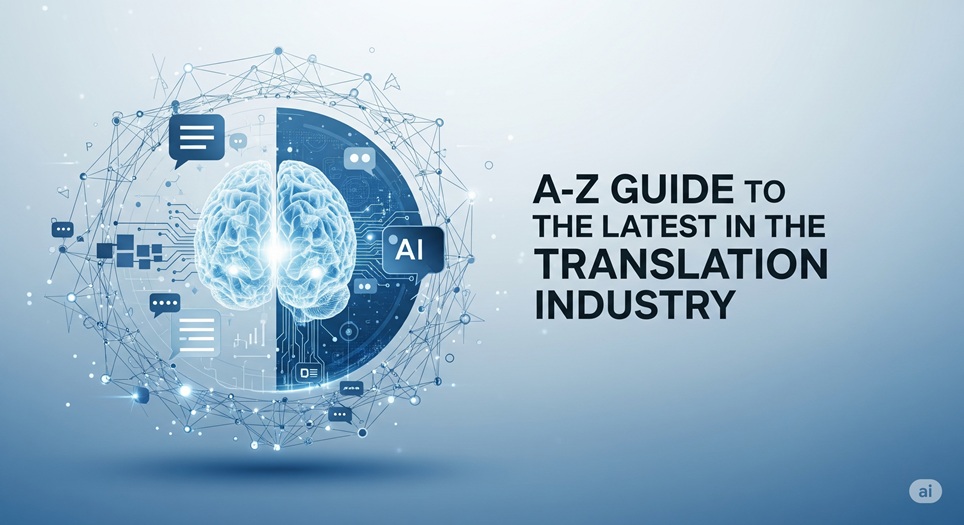
The translation industry is buzzing with innovation! Whether you’re a seasoned translator or a business seeking multilingual solutions, staying updated with evolving terminology is key. Understanding these terms will help you navigate new technologies, optimize workflows, and make informed decisions.
Here’s an A–Z breakdown of essential current terms you need to know:
A
- AI-Assisted Translation (AIAT): Refers to the use of Artificial Intelligence (AI) tools to assist human translators, rather than fully automating the process. Think intelligent CAT tools suggesting translations, improving consistency and speeding up workflows.
- Adaptive MT (AMT): Machine Translation (MT) systems that continuously learn and improve based on human feedback and corrections during the post-editing process. The more you post-edit, the smarter it gets!
B
- Bias in AI/MT: A critical concern where AI or MT systems perpetuate or amplify existing societal biases present in their training data, leading to inaccurate or unfair translations—especially in sensitive contexts.
- Blockchain for Translation: Still emerging, this involves using blockchain technology for secure, transparent, and immutable record-keeping of translation projects, payments, and intellectual property rights — with growing interest in localization compliance and project traceability.
C
- CAT (Computer-Assisted Translation) Tools 2.0: Beyond traditional CAT tools, these next-gen platforms integrate advanced AI features, real-time collaboration, and enhanced quality assurance functionalities.
- Cloud-Based Translation Management Systems (TMS): TMS platforms hosted on the cloud, offering greater accessibility, scalability, and collaborative features for managing translation projects from anywhere.
- Content Localization: Adapting entire content — text, visuals, multimedia, and even UX — to ensure cultural, social, and linguistic resonance with local audiences.
D
- Data Privacy & Security in Translation: With increased data exchange, this emphasizes the paramount importance of protecting sensitive information throughout the translation workflow, adhering to regulations like GDPR.
- Deep Learning in MT: A subset of machine learning that uses deep neural networks to process complex data and achieve highly sophisticated machine translation.
E
- Ethical AI in Translation: A growing discussion around the responsible development and deployment of AI in translation, addressing issues like bias, fair compensation for human translators, and data usage transparency.
F
- Federated Learning (for MT): A decentralized machine learning approach where MT models are trained across multiple devices or organizations without centralizing the data, boosting privacy and scalability.
G
- Generative AI for Translation: AI models (like Large Language Models – LLMs) that can generate human-like text. Now being explored for tasks like drafting initial translations, summarizing source content, or even creating source text itself.
- Global Content Strategy: An overarching plan for creating, managing, and distributing content across multiple languages and cultures, ensuring consistency and effectiveness worldwide.
H
- Human-in-the-Loop (HITL) Translation: Emphasizes that despite technological advancements, human oversight and intervention remain crucial in the translation process, ensuring quality, nuance, and cultural appropriateness.
- Hybrid Translation Workflows: The combination of various translation methods – human translation, machine translation, and post-editing – tailored to specific project needs to optimize speed, cost, and quality.
I
- In-Country Review (ICR): A vital step where translated content is reviewed by native speakers living in the target country to ensure cultural appropriateness and local market resonance.
- Intelligent Quality Assurance (iQA): AI-powered QA tools that go beyond basic spell-checking to identify more complex errors, inconsistencies, and even stylistic issues in translations. (Tools like ContentQuo or TAUS DQF are emerging here.)
L
- Linguistic AI: The application of AI specifically to linguistic tasks, encompassing areas like natural language processing (NLP), machine translation, speech recognition, and text generation.
- Localization Maturity Model: A framework that helps organizations assess their current localization capabilities and plot a roadmap for improving their global content strategy and scaling localization efforts effectively.
M
- Machine Translation Post-Editing (MTPE or P.E.): The process of human translators reviewing and correcting output generated by machine translation engines to achieve publishable quality. Now a core skill for many translators.
- Multimodal Translation: Translating content that combines different modes — text, images, audio, and video — requiring a holistic approach to convey meaning across formats.
N
- Neural Machine Translation (NMT): The dominant form of MT today, which uses neural networks to learn the relationships between words and phrases, producing more fluid and contextually accurate translations than older MT methods.
- Natural Language Processing (NLP): A field of AI that enables computers to understand, interpret, and generate human language. NLP powers modern MT engines, AI tools, and voice assistants.
O
- Ontology in Translation: The use of structured knowledge representation (ontologies) to improve translation consistency and accuracy, especially in highly specialized or technical domains.
P
- Post-Editor (P.E.): A specialized translator whose primary role is to edit and refine machine-translated text.
- Prompt Engineering (for LLMs in Translation): The art and science of crafting effective prompts for Large Language Models (LLMs) to generate desired translation outputs, glossary suggestions, tone adjustments, or QA support.
R
- Responsible AI Development: The ethical principles and practices guiding the creation and deployment of AI in translation, aiming to mitigate risks and maximize societal benefits.
- Remote Interpreting (RI) / Remote Simultaneous Interpreting (RSI): Interpreting services delivered remotely via video conferencing platforms — now standard for global meetings and multilingual events.
S
- Speech-to-Text (STT) & Text-to-Speech (TTS) in Translation: Technologies that convert spoken language into written text (STT) and vice-versa (TTS). Increasingly used in subtitling, accessibility, and multimedia localization.
- Synthetic Data for MT Training: Artificially generated data used to train MT models, particularly useful when real-world data is scarce or sensitive.
T
- Translation Memory (TM) Evolution: Beyond simple segment matching, TMs are becoming more intelligent, leveraging AI to offer context-aware suggestions and identify patterns across multiple datasets.
- Transcreation 2.0: Moving beyond just creative adaptation, this now often involves leveraging AI tools to analyze cultural nuances and target audience preferences to inform the creative process.
U
- User-Generated Content (UGC) Localization: The challenge and opportunity of translating content created by users — such as reviews, forum posts, and social media — while handling informal language, slang, and inconsistent grammar.
V
- Voice AI in Translation: The growing use of AI for real-time voice translation and interpretation, especially in conversational AI platforms and smart devices.
X
- XML Localization Interchange File Format (XLIFF) 2.0: An updated standard for exchanging translatable data between different CAT tools and TMS platforms, with improvements in metadata handling and interoperability.
Z
- Zero-Shot Translation: The ability of an MT model to translate between language pairs it has not been explicitly trained on. Still largely theoretical for high-quality output, but showing promise in low-resource languages and research environments.
For Translators:
Embrace these terms! Understanding them will help you adapt your skills, explore new roles (like post-editing or prompt engineering), and leverage cutting-edge tools to enhance your efficiency and service offerings.
For Translation Buyers:
Familiarizing yourself with this vocabulary will empower you to make more informed decisions about technology adoption, vendor selection, and global content strategy.
Looking to leverage these innovations for your business? Transpanish offers cutting-edge AI translation and professional post-editing services to ensure high-quality, efficient, and cost-effective linguistic solutions.